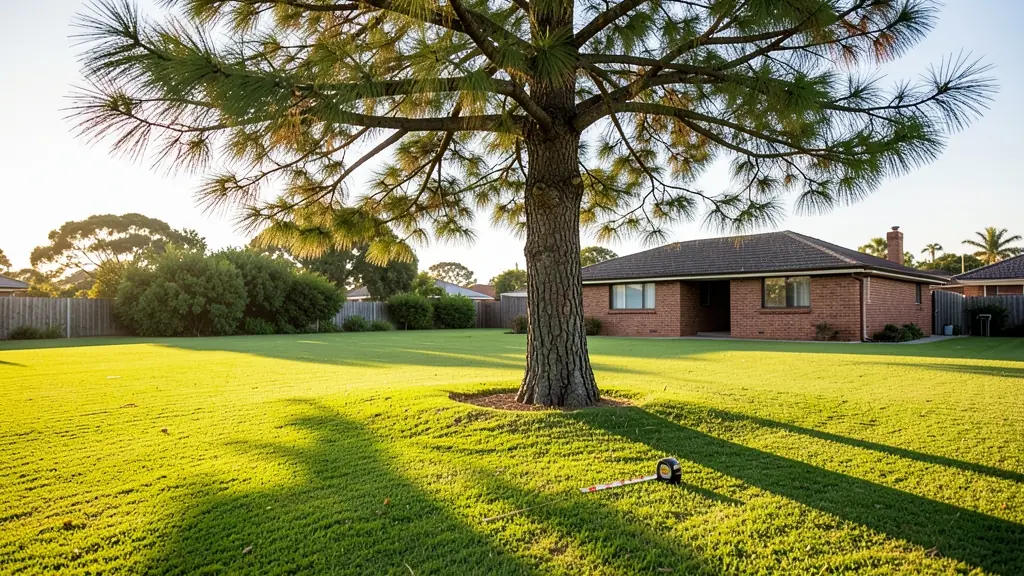
Height is the first number every tree feller asks for, because it decides the price band, the equipment and whether the tree can be felled whole. It is also the number most people guess badly: trees look shorter than they are, and a gum that "looks about ten metres" is often eighteen. You do not need to climb anything to measure it. A sunny day and a tape measure, or a phone that can show an angle, are enough to get within a metre or two.
Three ways to measure a tree
- The shadow method. On a sunny day, measure your own shadow and the tree's shadow at the same time. The tree is as many times taller than you as its shadow is longer than yours. It works best in the morning or afternoon on flat ground, when the shadows are long and the tip of the tree's shadow is easy to find.
- The angle method. Stand a measured distance from the trunk, on level ground, and read the angle up to the top of the tree with a clinometer or a phone level app. The height is the distance times the tangent of the angle, plus your eye height. Standing back about as far as the tree is tall gives the most accurate reading.
- The stick method. Hold a straight stick upright at arm's length, with the part above your hand as long as the distance from your eye to your hand. Walk back until the stick exactly covers the tree from base to tip. The distance from you to the trunk, plus your eye height, is the height of the tree.
Shadow: H = tree shadow × your height ÷ your shadow
Angle: H = distance × tan(angle) + eye height
Stick: H = distance + eye height
The drop zone: what the tree can reach
A tree felled whole lands roughly its own height away from the stump, and the crown can bounce, roll or throw branches further, especially on a slope. So anything closer than the tree's height is in reach, and anything within about one and a half times its height is close enough to need care. That is the difference between a tree that can be dropped in one piece in the open and one that has to come down in sections, lowered on ropes, which costs more and takes longer. See sectional tree cutting for how that is done.
For people, the rule tree fellers work to is wider: keep everyone who is not part of the crew at least two tree lengths away while a tree is coming down. Children, dogs and neighbours over the wall count.
Leaning trees and trees on a slope
If the tree leans, measure the height to the point straight above where the top is, not along the trunk, and measure the drop zone on the side it leans towards: a leaning tree wants to fall that way, and a team can only pull it a little against its lean. On a slope, take the angle reading from the side of the tree at the same level as its base, or the answer will be too high or too low.
A tree that has started to lean more after rain or wind, has cracks or fungus at the base, or has lifted soil on one side is a job for an arborist or an emergency tree removal team, not a measuring exercise. Stay out of its drop zone.
Using the height in a quote
Put the height and the distance to the nearest building, wall or line in the felling plan at the bottom of the page. The plan draws the tree from above with its drop circle, the same way the calculator does, and the teams who quote see the same picture. The tree felling cost calculator turns the height into a price range.
Frequently asked questions
How can I measure the height of a tree without climbing it?
How far will a tree fall?
How tall is a typical bluegum or pine in a South African garden?
Does a tall tree always have to come down in sections?
More free tree tools
- TL-01Tree Felling & Removal Cost CalculatorTrees and palms, by height, with extras
FREEno sign up - TL-03Stump Grinding Cost CalculatorPer stump by width, or hire a grinder
FREEno sign up - TL-042 Stroke Mix Ratio CalculatorOil for your petrol, any ratio
FREEno sign up - TL-05Firewood CalculatorLogs or a tree to m³, kg and loads
FREEno sign up - TL-06Protected & Invasive Tree CheckerCan I cut this tree down?
FREEno sign up