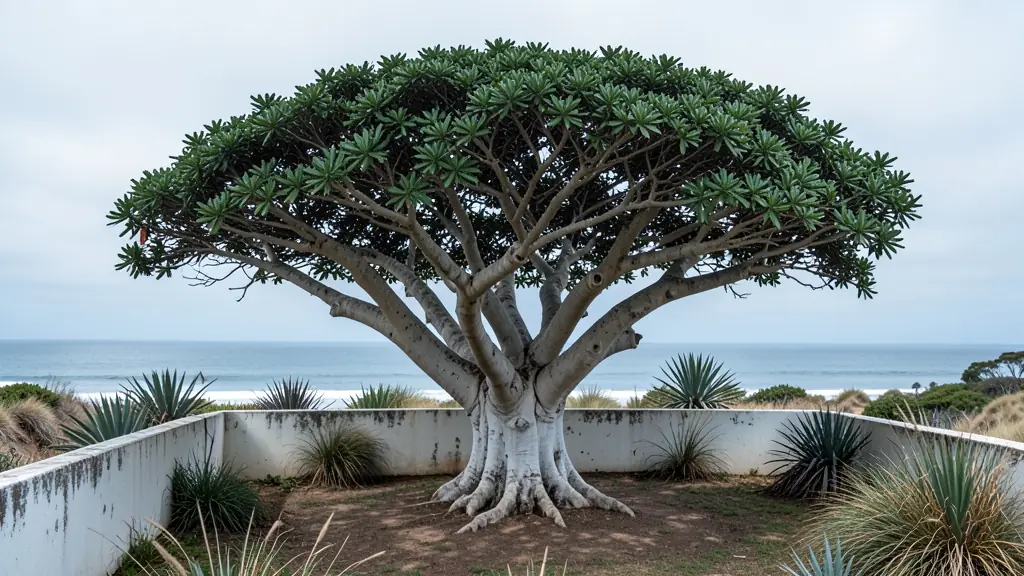
Before any tree in South Africa is felled, two national lists are worth checking. The first is the list of protected trees under the National Forests Act: those trees may not be cut, damaged, pruned, moved or have their wood collected without a licence, even on your own property and even when dead. The second is the list of alien and invasive species under the Biodiversity Act, which tells landowners which trees they must remove and control, and which they may keep. Many garden trees are on neither list, and then the only rules are those of your municipality, estate or body corporate.
Protected trees: what the licence covers
The Minister responsible for forestry publishes the list of protected tree species under section 12 of the National Forests Act (Act 84 of 1998) and updates it from time to time. Under section 15, nobody may cut, disturb, damage or destroy a protected tree, or possess, collect, move or sell any product of one, without a licence from the national forestry department (the Department of Forestry, Fisheries and the Environment). Applications go to its regional forestry office, usually with photographs, the GPS position, the reason and sometimes an arborist's report. A tree that is a danger to people or buildings can be licensed for removal; allow several weeks.
The checker lists the protected trees most often met in gardens, farms and towns. The list also includes rare forest and mangrove species; for the full, current list, see the department's published notice. If a team offers to remove a protected tree without asking about a licence, that is a warning sign: the fines fall on the landowner too.
Invasive trees: the categories
- Category 1a: must be fought and eradicated. Few trees are in it.
- Category 1b: must be controlled, and removed where possible. They may not be planted, bred, moved or sold. A property seller must disclose them to the buyer.
- Category 2: allowed only in a demarcated area under a permit, such as a plantation or woodlot. Outside that area they are treated as 1b.
- Category 3: plants already growing may stay, but they may not be planted, propagated or sold, and in riparian areas and wetlands they count as 1b.
The categories of many trees differ by province or by setting, for example a gum in a plantation versus the same gum on a river bank. The checker gives the usual position; your provincial conservation authority or a registered arborist can confirm it for a particular tree. Removing invasive trees is covered under alien tree removal.
Other permissions to check
- Street and pavement trees usually belong to the municipality, which prunes and fells them itself or gives written permission.
- Heritage trees and trees in heritage areas can be protected by the municipality or the provincial heritage authority.
- Estates, complexes and body corporates often need approval for any tree work, and some require a registered tree feller.
- Power lines: trees in or near the servitude are cut by the utility or its contractors, or with their written consent.
When the answer is clear, the tree felling cost calculator gives a price range, and the felling plan below sends the job to tree fellers near you.
Frequently asked questions
Do I need a permit to cut down a tree on my own property in South Africa?
Is the white milkwood a protected tree?
Do I have to remove invasive trees on my property?
Is the jacaranda tree protected?
More free tree tools
- TL-01Tree Felling & Removal Cost CalculatorTrees and palms, by height, with extras
FREEno sign up - TL-02Tree Height & Drop Zone CalculatorShadow, angle or stick, then its reach
FREEno sign up - TL-03Stump Grinding Cost CalculatorPer stump by width, or hire a grinder
FREEno sign up - TL-042 Stroke Mix Ratio CalculatorOil for your petrol, any ratio
FREEno sign up - TL-05Firewood CalculatorLogs or a tree to m³, kg and loads
FREEno sign up